Your company's hidden cost
Do you know how much it costs you to have your team work as copyists between WhatsApp, printed sheets and Excel?
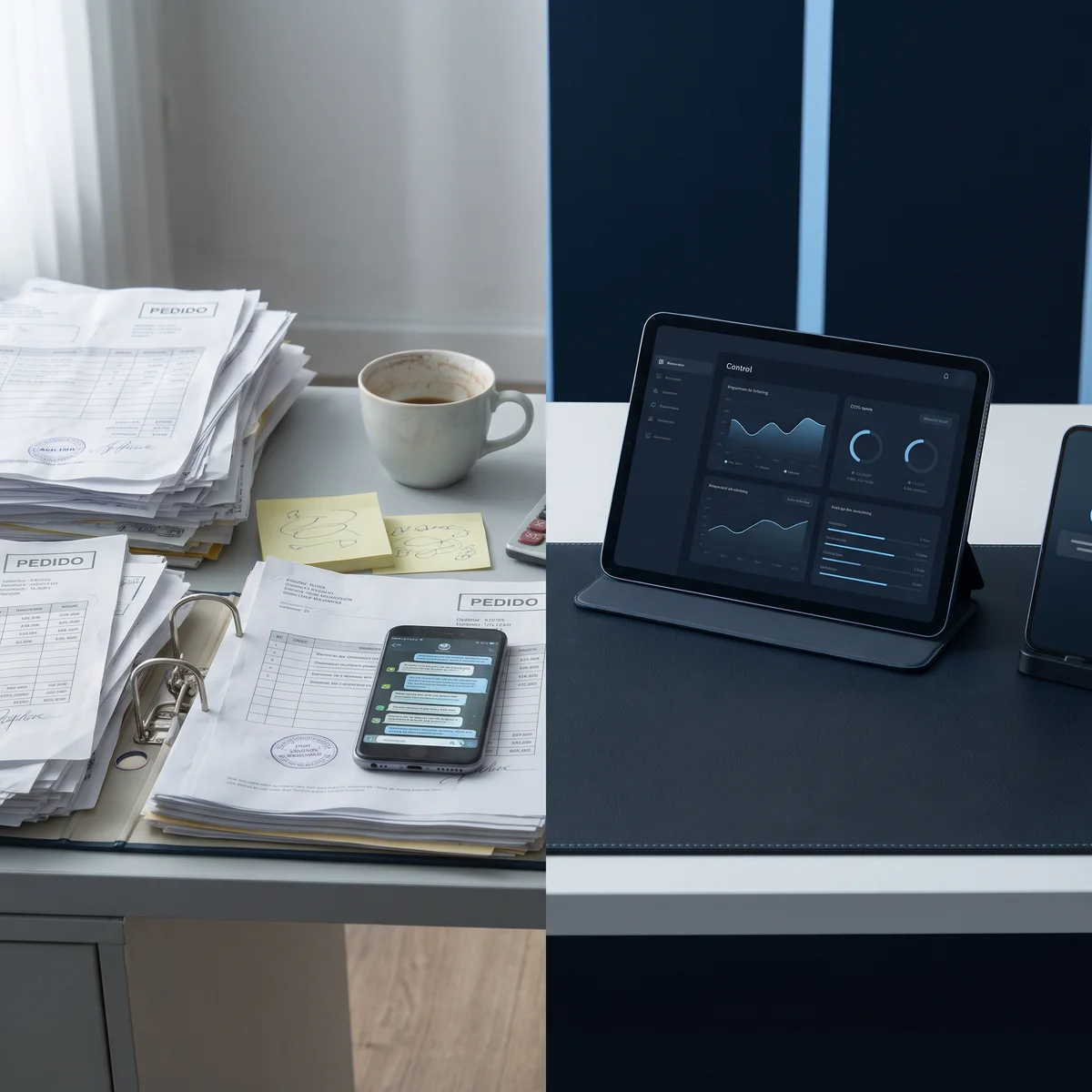
It’s six in the evening and an urgent order comes in over WhatsApp. Someone prints it so the supervisor can sign it. Someone else enters it into the orders spreadsheet. The warehouse enters it again in its inventory log. And the next day, accounting types it in one more time so it can be invoiced.
Nobody at the company calls this a problem. It’s “the way we work.” But that same piece of data was written four times, and every entry has a cost almost nobody measures: payroll hours spent copying, errors that have to be fixed and invoices that go out late because they were waiting for a signature. In a sample calculation for a mid-sized company, with conservative assumptions, that cost comes to around $79,500 Mexican pesos a month. It doesn’t show up on any line of the income statement because it’s spread across all of them.
The problem isn’t your people. It’s a process that forces them to work as copyists. In this article we show you where the money is lost, why the usual fixes don’t solve it and how we remove it at the root with a very simple engineering principle: one piece of data, one entry.
Where the money is lost: the patchwork trap
When the paperwork starts to hurt, almost every company reacts the same way. They relieve the symptom and leave the cause untouched. These are the four places where money slips away:
- Double entry is paid for in payroll. Every time someone types what was already written somewhere else, you’re paying for hours of work that don’t sell, don’t ship and don’t collect. In the example, that’s 330 hours a month between entering and correcting.
- Hiring another data-entry clerk turns the problem into a fixed cost. It handles this week’s load, but more orders mean more people copying. The cost grows at the same pace as your sales.
- Scanning paper to PDF isn’t automation. A PDF of a signed sheet is still a signed sheet. Someone has to open it, read it and type what it says all over again.
- A system that doesn’t integrate adds one more entry. It arrives with the promise of putting everything in order, but it doesn’t talk to invoicing, the warehouse or collections. The result is the same data, now written in one more place.
One piece of data, one entry: the engineering solution
At OMNI TECHX we solve the paperwork with The X Method: 01 × ASSESSMENT, 02 × DESIGN, 03 × ENGINEERING and 04 × ADOPTION. The principle behind all the work is that data is recorded only once, where it originates, and from there it reaches every area on its own. It rests on three pillars:
- Capture at the source. The order is recorded where it originates: a mobile form for the salesperson, a portal for the customer or an integration with the channel it already comes through. The supervisor approves it from their phone, with a digital signature and traceability. Benefit: the hours that go into re-entering data today return to the operation, and the sheet waiting for a signature on a desk disappears.
- A single source of truth. Business rules are validated at entry, not three steps later. Once validated, the order automatically feeds the invoice, the inventory reservation, collections and the management dashboard. We build it with C#, .NET and PostgreSQL on a clean architecture, with working deliveries every week. Benefit: fewer errors to fix and invoices that go out the same day, which speeds up cash flow.
- Measurement from day one. Before we build, we put a number on the problem: monthly cost = entry hours × cost per hour + errors × cost to fix each one + cost of collecting late. We measure those same variables during adoption, with training, metrics and continuous improvement. Benefit: management sees, with data from its own operation, how much it stopped paying, instead of relying on promises.
Executive summary
Paperwork isn’t an unavoidable administrative expense. It’s a process design that forces valuable people to write the same thing several times, and that takes visibility, time and margin away from management. When technology is designed around the real operation, and not the other way around, data stops getting lost between WhatsApp, paper and Excel, and control returns to whoever makes the decisions.
The first step isn’t buying a system: it’s knowing how much it’s costing you today and at exactly which step it’s lost. Book a 15-minute Operational Assessment Session at omni-techx.com. We’ll understand how a piece of data travels through your company and tell you honestly how we would solve it.